X
ETF - Market Timing Service

Premium Stocks Service










DJIA Historical Charts
1929 DJIA vs. Nasdaq Crash
Buy & Hold Days

Yahoo! Econ. Calendar
StockCharts.com
Yahoo! Finance
TheStreet.com
BigCharts.com
eSignal.com

Make Us Your Home Page
Financial Server
Private Policy
Disclaimer
Link-To-Us
Feedback
Dated: Nov. 22, 2001
In the past, the buy-and-hold philosophy was a great way to invest. But, we believe the buy-and-hold days are over for now. We would like to explain to site visitors and members our opinion about this.
To start, let's take historical data and construct a yearly linear chart of the Dow Jones Industrial Average (DJIA) all the way back to the beginning of the 20th century up to today, 2001 (chart below). Looking at this chart, we see the stock market going ballistic after the early 1980s. If one didn't know anything about the history of the market before this time, one would assume it didn't seem to be doing much of anything. But it did. The market had a vast history with painful times as well as prosperous times.
When we re-construct the data into a yearly logarithmic chart (log chart), things begin the pop out and become a little more clearer. Percentage charts work just as well to accurately present stock history. Here is the same period in a log chart.
Now, let's get down to the nitty gritty and analyze and label parts of this chart. Let's also lump the chart into bad times and good times.
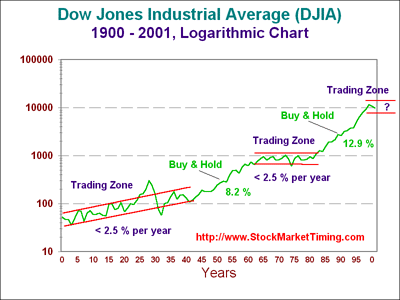
Bad Times: Two rather devastating periods can be seen. One was during the Great Depression when there was a significant drop in the late 20s and early 30s. Another during the collapse of the market in 1973 and 1974. Since these charts are yearly charts, meaning we used one data point per year (value for the last trading day of each year), the crash of 1987 does not show up. This is because 1987 was still a profitable year, unbelievable, but true!
Other bad times? Yes. Looking at the history of the market, we see there were times when the market practically goes nowhere for years, possibly decades. We will label these periods as "Trading Zones". This is because if if one would have invested in mutual funds or solid blue chip growth stocks, the buy-and-hold strategy would have done nothing over these long periods of time.
How long of periods? How does over 40 years sound? From 1900 to 1943, the DJIA only increased at a rate of return of 2.3% per year. Another stagnant and long duration was from about 1962 to 1982 (20 years), when the DJIA only increased at a rate of 2.4% per year. These are the dangers of buy-and-hold investing. Now lets look at the flip side of the coin, the good times.
Good Times: There were two intervals when the buy-and-hold strategy worked rather nicely. One period was from about 1943 to 1962 (19 years), when the DJIA had a rate of return of about 8.2%, and another from 1982 to 2000 (18 years), having a 12.9% rate of return. Yes, those were super times to ride the mutual fund wave!
Where are we now? As we all know by now, the market has recently been through hell! We won't go into details, but the majority of investors during the last couple of years probably took a hit to their portfolio. Many people say the worst is behind us. But is it? As labeled on the chart, we believe we are at the beginning of a new major trading zone. No one can predict the future of the market, and no one knows how long this zone will last. You can be the judge of this duration of time. However, we believe that investors will probably "not" make money with the buy-and-hold strategy of investing for the years to come.
What are we to do as investors? It is our opinion that we have to become better traders in the market in order to make our money grow for the next few years. And, until this market breaks out of this trading zone, which may be in 10 to 20 years (our guess), this site will be in operation! This is only the tip of the iceberg of what we have found. After analyzing all of the indicators and oscillators that technical analysts use from start to finish, we believe we have mathematically produced a good timing indicator to make our money move forward by going long and short at appropriate places while in the zone.
We hope this information better informs site visitors and members of our position or philosophy of the stock market. Our primary goal is to help our members move their money forward! We welcome you to join now!


Copyright © 2000 - 2017 StockMarketTiming.com, LLC. All rights reserved.